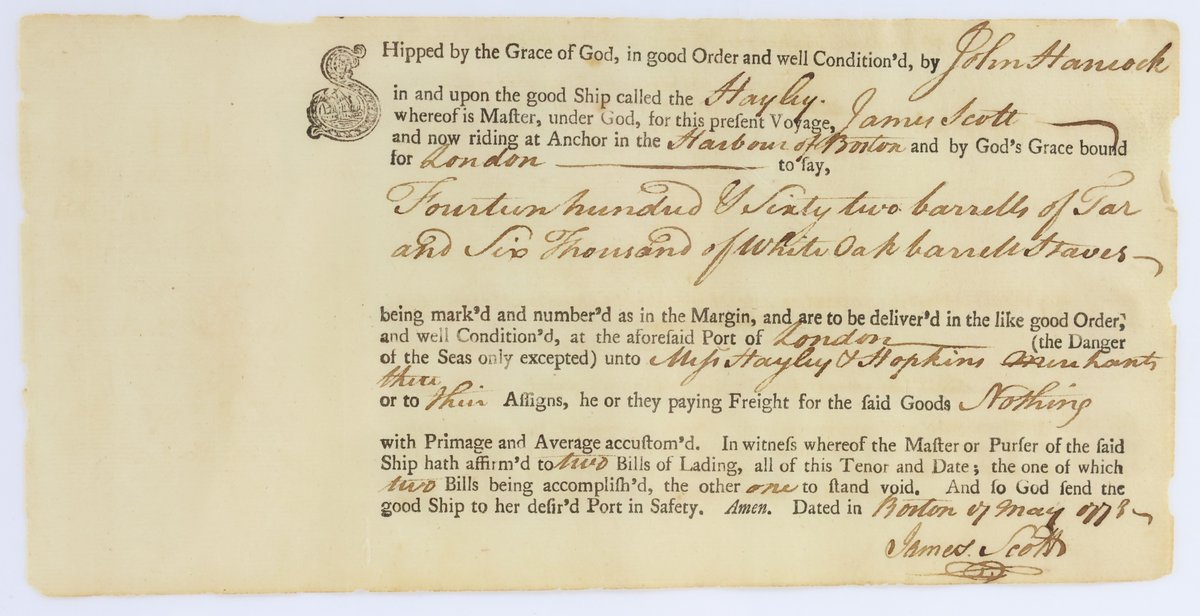
#6203 • American Colonial Shipping Document-John Hancock's Ship
Part of Fine Arts and Mid-Century Modern Design | June 11, 2026 at 10:00 AM (live auction by Alderfer Auction)
High bid $1,300.00
Status: SOLD
Important American colonial shipping document dated May 17, 1773 for goods (1462 barrels of tar and 6000 white oak barrel staves) being shipped on John Hancock's ship the Hayley from Boston harbor to London. The materials were to be delivered to Miss Hayley & Hopkins, merchants. The document is signed by the ship's captain, James Scott. James Scott (1746–1809) was a long time ship captain working for Thomas Hancock starting around 1764 and then for his heir and nephew, John Hancock who would become the governor of Massachusetts, a Founding Father and a signer of the Declaration of Independence. Scott would usually make two round trip voyages between Boston and England per year. During the American Revolution Scott would stay in England, however when peace was declared Hancock convinced Scott to return to North America and return to the employ of Hancock in captaining ships that traveled between Boston and England. When John Hancock died in 1793, his widow Dorothy Q, Hancock eventually marry Scott in 1796. Approximately 3 months after the document in this lot was issued, Scott captaining the Hayley left London carrying manufactured goods and passengers including Jonathan Clarke who helped secure the consignment arrangement with the East India Company to receive tea in Boston. The Hayley left shortly before several other ships loaded with East India Company tea bound for Boston. The Hayley arrived in Boston before these other ships and conveyed information of the tea laden ships imminent arrival. A short time later on December 16, 1773 colonial patriots would dump a large portion of this tea into Boston harbor that would light the fuse for what would be the beginning of the American Revolution a little more than a year later at Lexington and Concord in April 1775. After the "Tea Party" the Hayley would sail for England being one of the first ships to arrive with news of the colonist's civil actions. This document is a rare relic with a peripheral connection to one of Colonial America's most important events. Document measures 4.5" x 9" and exhibits some toning.