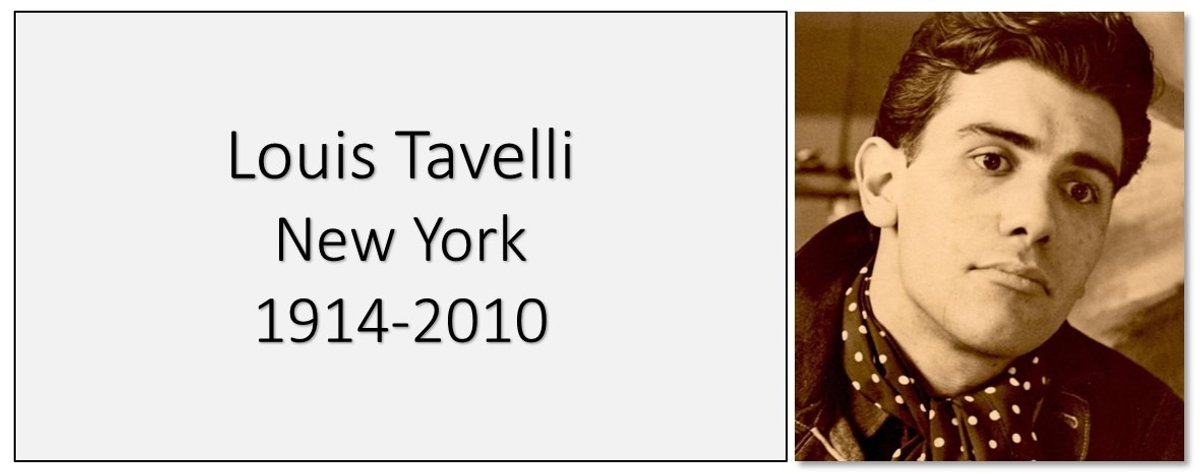
#1872a • Biography - Louis Tavelli (1914–2010)
Part of Discovery Art | October 21, 2026 at 7:00 PM (timed auction by Alderfer Auction)
Starting at $5.00
Status: Available
Bidding closes Oct 21, 2026 7:19 PM EDT
Louis Tavelli (1914–2010) was a multitalented American artist whose life and work defy easy classification. Known equally for his achievements in abstract expressionist painting and classical music, Tavelli spent more than six decades immersed in a creative journey that explored the emotional range of both disciplines. His story is one of resilience, experimentation, and an enduring devotion to the expressive power of form, sound, and color. Born in Williamstown, Massachusetts, Tavelli was introduced to music at an early age by his mother, a pianist who recognized and nurtured his talent. By the time he was nine, he was already performing on violin and viola. This early start led him to a scholarship at the prestigious Eastman School of Music in Rochester, New York. But alongside his musical studies, Tavelli was also beginning to develop a deep affinity for visual art. This dual passion would shape the rest of his life. During his college years, Tavelli began visiting Woodstock, New York—a thriving artistic community known for its openness to new ideas and creative experimentation. These summers were formative. He and his string quartet performed at parties held in the summer mansions of the Catskills, while he worked in his studio, surrounded by painters, dancers, musicians, and writers. Woodstock wasn’t just a retreat; it was a laboratory for his evolving vision. Eventually, Tavelli bought property there and established a permanent studio on Maverick Road, where he often hosted gatherings around bonfires with local creatives, including his friend and fellow artist Philip Guston. Tavelli’s artistic education included time at the Colorado Springs Art Center and the Art Students League in New York. He later taught painting at several respected institutions, including the University of North Carolina, Cooper Union, and the University of Michigan. His style evolved in tandem with the major art movements of the 20th century, reflecting early influences from post-impressionism, cubism, and Asian calligraphy. Over time, his work matured into a distinct abstract expressionist language that emphasized movement, emotion, and materiality. Like many of his generation, Tavelli’s creative journey was interrupted by World War II. Drafted into the U.S. Army, he continued to make art while stationed at a base in Louisiana, sketching whenever possible and even forming a string orchestra among fellow servicemen. Upon returning, he resumed both his painting and musical careers, yet remarked later in life that he had “missed” the height of the Abstract Expressionist movement. Nevertheless, its aesthetic and energy became central to his work. He absorbed the innovations of artists like Guston and Bradley Walker Tomlin, reinterpreting their approaches through his own sensibility. His paintings from the 1960s feature floating brushstrokes, subtly tinted color fields, and gestural marks that evoke misty landscapes or seascapes—what he described as a synthesis of “remembered landscape” and the physicality of paint. A significant shift occurred in 1983 during a tour of Spain with his chamber music ensemble. Tavelli visited the Paleolithic cave paintings in Altamira, and the experience left an indelible mark on his art. Inspired by the raw power and layered imagery of these ancient works, Tavelli began to incorporate symbolic forms and textures into his compositions—hunters, bulls, abstracted faces, and gestural symbols that connected his modern practice to humanity’s earliest expressions. The rawness, urgency, and primal emotion of these cave paintings resonated with his interest in survival, identity, and the fragility of the human psyche. This influence is evident across a wide range of themed collections preserved by his estate. These include expressive landscapes rendered in acrylic and pastel; symbolic cave-inspired pieces; fragmented, emotional studies of faces and psychosis; and dynamic collages of musicians. His work ranges from the serene to the chaotic, unified by a deep emotional current and a painterly approach rooted in movement and rhythm. While his artistic output remained consistent, Tavelli’s personal life was not without difficulty. In 1962, after a nervous breakdown, he returned to his hometown of Williamstown, where he focused on raising his daughter, Gina, and performing music locally. Despite continued struggles with alcoholism, which affected his ability to promote his work publicly, Tavelli never stopped creating. In 2003, when Gina moved him into an assisted living facility, she uncovered a vast and largely unseen body of work—testimony to decades of quiet, focused labor. Throughout his life, Tavelli exhibited in notable galleries and institutions across the country, including one-man shows at Bennington College, Williams College, the University of Michigan, and the State Museum of Art in Raleigh. He also participated in group exhibitions at galleries such as Hacker, Camino, Berta Schaeffer, and the Woodstock Artists Association, reflecting his deep ties to both the academic and independent art worlds. Louis Tavelli’s legacy is that of a dedicated artist whose life was defined by exploration—of medium, of self, and of the human condition. His work offers a compelling dialogue between abstraction and figuration, between surface and depth, and between past and present. Whether viewed as visual music or symbolic narrative, his art stands as a testament to a lifetime spent seeking connection through creativity.